The Nature of Professional Development

I wrote the below for the Teachers and Writers Collaborative E-Newsletter, to report on what we’re up to here. I got to sit in on a lovely Professional Development session with public school teachers and a T&W vet on Veteran’s Day,  one of only two city-wide PD days for NYC.  Professional Development has come to have so many different meanings and so many implications.  Over-professionalization of the field.  Artless, boring, dry sessions on testing practices.  When I was a teacher, so rarely was PD something to look forward to, much less learn from or enjoy.

In this particular case, I was moved to see teachers put in the position of their students, writing personal pieces though it’s scary and hard.  For, we can often be our best selves as teachers when we truly understand the difficulty in what we’re asking our students to do and have had to fight through fears to be brave and master the skills or create something specific and true.

***

In the airy, book-lined Center for Imaginative Writing at Teachers & Writers Collaborative, a group of teachers from Aviation High School are buried in their notebooks, scribbling out their responses to a prompt by Karen Ulrich, a T&W writer and author of How to Write Your Life Story.  “Today, our goal is to write a scene from your memoir.”  This felt big to me, a big goal.  But I took a deep breath and put myself in Karen’s capable hands.

Karen gave us an excerpt of her book which contained a list of prompts on “memory triggers.”  Turning points-decisions that changed your life. Regrets.  Secrets you have kept.  World events that have had a powerful effect on your life.  “Choose one that you are especially interested in writing about and make a list of moments in your life that apply to that category,” she encouraged.  She then asked us to select the one that we were most curious about. This would be the kernel of the memoir piece.

As the workshop went on Karen showed us how a unit on memoir can be employed to teach good writing technique for both fiction and nonfiction.  She started with character.  Karen said, “List traits of you at the moment in time you’ve chosen.”  I had used the world events prompt and from my list, I’d chosen the Blackout of 2003.  What was I like then?  “Bob haircut.”  “Tall shoes.”  “Always bustling.”  “A bit meek with authority.” Listing in this way helped me to examine myself from the outside and without prejudice.  More importantly, it helped me to find the voice for this protagonist-me in 2003.

We then moved on through setting, plot, sensory detail, and dialogue.  As each aspect was introduced, we did a bit of writing with that technique or device in mind.  At the end, Karen asked us to take the very best bits out of what we’d written and to cobble it together into a whole.  This seemed much less scary than being told to build a memoir piece from scratch.  Instead we had small bits which we could collage together into a cohesive piece.  In this way, Karen modeled beautifully how a teacher could take this work into the classroom and create a well-scaffolded unit for his or her students.

The teachers shared some of their final pieces and they were textured, with strong charismatic characters and richly drawn settings.  You could see that they were surprised by each other’s work and how personal and authentic it was.  For those who read aloud, there was a palpable sense of the pride in building and sharing this piece of memoir.

So, while they walked out armed with Personal Fiction Writing by Meredith Sue Willis (T&W, 2000), handouts from Karen’s own book, and samples of memoir writing, more importantly, they walked away with their own memoir pieces and the memory of having participated in this process so that when they ask their students to be brave and to write about something true, they will be able to say, “Yes, I’ve done that that too.  And it’s hard.  But it’s worth it, I promise you.”
Classroom Theater

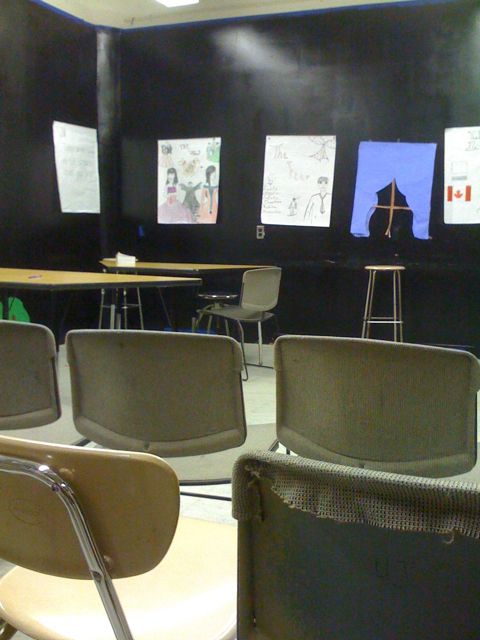
Imagine for a second that you were rehearsing whatever show it is that you are currently working on, with a group of 4-5 collaborators. So, you are in your rehearsal room, hammering it out, working on the script, figuring out the blocking, etc.

And then, in walk 4 other groups, to share your room. They are also rehearsing with their props, costumes, text, choreographed fight sequences, etc. This is the situation in the typical NYC public school classroom that I walk into. There will be 30 students, rehearsing simultaneously in a space the size of your living room. If you have a big living room. I could probably only fit 4 students in my living room. But, you get the picture.  This was the situation yesterday at an International High School in Queens where I was doing some residency culminating performances.

“What?” you say.

“How do you hear yourself above the din?”

“Aren’t you tripping over each other?”

The answer is that in working in schools, doing drama, this is the way it is. We make it work, somehow. But, unlike the fine arts, or perhaps even dance, this means a lot of chaos, more chaos than people are used to seeing in classrooms.

I taught with two guest teachers as my primary colleague was out. Part way through the first class, the two guest teachers shot some looks over, like, “are you mad?” The noise.  The questions.  The fact that students were using broomsticks as faux swords.  This is not what English class normally looks like.  But today, it is okay and I must also make them comfortable in the room.  I ask one teacher to model an activity with me to draw her in.  Show the students that she too will take the risk to get up and work in front of them.

I was to teach around the question, “What is point of view? And how does a story change depending on who’s telling it?”  And I ended up needing to teach each class very differently depending on the student group dynamics and language comfort.  While I came in with a plan, I ended up changing things on the fly, in order to better have them understand POV and be able to tell a story from a different character’s point of view.

When it came time to show the pieces the students magically whizzed together in a few minutes, the teachers seemed to enjoy them and were impressed with how much the students showed that they knew about the play, how inventive they were, how they moved through their shyness and varying levels of language acquisition challenges to create a moment of theater.

And perhaps I re-learned, we are always in process as teachers and artists and teaching artists. And we have to change things on the fly sometimes, because what we’re doing is not working. Or could work better. Our instincts are usually right. And momentary chaos is often okay. As long as we are seeking the answer to the driving question. Instincts are right. Chaos is good. This will be my mantra.

Crashing after the Sugar House

Oh, boy.  I was doing so well.  Made all 14 other Ma-Yi Labfest Readings and still managed to finish my play, rehearse it and get it up with the wonderful actors.

And then the next day I crashed.

Teaching has been especially hard this week because my energy has waned, I am fighting the dumb flu that everyone is sneezing and coughing around, and Teaching Artistry is a highly energetic, highly creative job.  Today was a good day, though.  I got to help some students at Flushing International HS scribe and rehearse plays–their “What happens next?” or “What other adventure could Jason go on?” in response to Jason and the Argonauts, the wonderful two-man version by Visible Fictions.

And then, I realized why I love theater–the rehearsal is really the fun part.  And, as Visible Fictions does, they were charged with using props, minimal costumes, action figures, to fill out the world.  Two fellows in two different classes built full dragon tail regalia.  There were sword fights with homemade swords.  Heroes who stood up to tyrants and brave princesses who defeated monsters.  I just tried to remind them to use what we learned, transforming our bodies and voices to become the characters and inventively using props and space.  Being students recently arrived, many are shy about using their English, but today, one girl I’ve never heard speak until today, powerfully spit out her lines.  Perhaps because it was “play,” the stakes were lower and she was able to engage in front of a crowd.  Joy.

All in all, a good day of play.

The Writing Process

Some people get sheepish talking about their writing process.  Particularly if you find yourself working at the last minute.  Or right up to deadline.  Do you make apologies?  Do you just forgo the sleep?  Do you foist it on some kind soul to read it at the 11th hour and make sure you’re not totally crazy and there is a discernible story there?

I am working up until the 11th hour to get this piece done for the reading.  It is massively nervewracking to put it before an audience, but perhaps that’s the only way to know if it works.  If it feels alright in the mouths of these wonderful actors.  If there is that feeling in the air during the reading.  You know the one.  When we’re all present and inside the story and breathing hard because of what just happened/is threatening to happen/can’t happen.

If you can get a moment or two of those, maybe you’ve got something going on.

So, that is what we’re trying for.  If this play would just cooperate.  I keep trying to whip it into shape and it keeps bleeding around the edges.  C’mon, play.  Stop being so messy and chaotic.  Or be more messy and chaotic.